



Your competitors are already cited in AI answers. You can be too.
Generative and answer engine optimization are delivered as part of SEO & AI Search Strategy, Parachute's single search retainer. AI answers draw on the same foundations as Google rankings, so the work runs together under one plan.
Book a Call
GEO is not automatic
Ranking on Google does not get you cited by ChatGPT, Claude, or Perplexity. Large language models pick sources based on authority, clear structure, and how directly your pages answer real prompts. Without deliberate work, you are invisible inside the answer.

AEO is a different game
Google AI Overviews and answer engines pull content into the result itself. Short, extractable answers, FAQ schema, and clean heading logic decide whether Google lifts your content or a competitor’s. Long-form authority alone does not win this surface.

The rules are changing fast
AI search is not future tense. AI Overviews appear in roughly 1 in 5 searches. Source lists inside AI Mode and ChatGPT change by 40 to 60 percent month over month, per EMARKETER. Every month you wait, competitors build authority you cannot recover quickly.
AI Search Optimization is built into everything we do.
We do not treat this as an add-on. It shapes how we write copy, structure content, implement schema, and build every page. One service, two named layers, three surfaces: classic Google, Google AI Overviews, and large language models like ChatGPT and Perplexity.

GEO Layer (Generative Engine Optimization)
GEO targets large language models like ChatGPT, Claude, Perplexity, and Gemini. We build long-form authority content, entity signals, consistent brand mentions across cited domains, and LLM-readable structure so your business gets named when a user asks an AI tool for a recommendation.

AEO Layer (Answer Engine Optimization)
AEO targets Google AI Overviews, AI Mode, featured snippets, and voice answers. We write direct, extractable answers, apply FAQ and HowTo schema, and structure pages so Google selects your content to appear inside the AI-generated answer at the top of the results page.
Shared Technical Foundation
Both layers need the same base: fast Core Web Vitals, clean semantic HTML, correct schema markup, proper robots.txt and llms.txt configuration, and crawlability for AI user agents including GPTBot, ClaudeBot, PerplexityBot, and Google-Extended. We handle this from day one.
THE COMPANY WE KEEP


“Since launching our new site with Parachute, our organic traffic increased by over 60% and we're now showing up in Google AI Overviews for our core services. We're getting calls from clients who found us through ChatGPT.”

Four areas we work on for AI Search Optimization.
AI engines will not cite a slow, broken, or poorly structured site. Research from Seer Interactive found that brands cited in AI Overviews earn 35% more organic clicks than competitors on the same queries. Non-cited brands absorb the full traffic loss.
Covered:
- Core Web Vitals and page speed
- Crawlability and indexability
- Schema markup (Organization, Article, FAQ, HowTo, Product)
- robots.txt and XML sitemap configuration
- llms.txt file creation for AI crawler access
- Clean, semantic HTML structure
- Mobile performance
- SSL, canonicals, and redirect hygiene
- AI crawler access control (GPTBot, ClaudeBot, PerplexityBot, Google-Extended)
Every page needs to speak clearly to humans, Google, and AI. We optimize each page for citation and direct-answer selection.
Covered:
- Answer-first content blocks tied to specific questions
- FAQ sections with FAQPage schema
- HowTo schema for process and instructional content
- Heading hierarchy aligned with how AI parses content
- Keyword and AI query research (Google, ChatGPT, Perplexity)
- Meta titles, descriptions, canonicals
- Image alt text and contextual signals
- Internal linking for authority distribution
AI tools cite sources they treat as authoritative. According to BrightEdge, 80% of sources cited in AI Overviews do not rank organically in traditional results. Authority signals, not rankings, decide who gets cited.
Covered:
- Long-form pillar content that LLMs can summarize and cite
- Named expert authors and author schema
- Original research, data, and statistics worth quoting
- Consistent entity signals across your site and third-party mentions
- Topic-cluster architecture that signals depth
- Brand mention building on domains LLMs reference (Reddit, LinkedIn, YouTube, industry publications)
- Content refresh cycles to stay inside AI training and retrieval windows
For businesses serving Toronto and the GTA, local signals matter across both layers. AI tools use Google Business Profile data, local citations, and location-specific content when a user asks for a recommendation near them.
Covered:
- Google Business Profile optimization
- Local directory citations and NAP consistency
- Location-specific landing pages with LocalBusiness schema
- Review acquisition strategy (AI tools surface review signals)
- City and neighbourhood content relevant to your service area

Web Design
Hand-crafted responsive website design that not only turns heads but consistently converts visitors into customers.

Web Development
Custom website development on WordPress, built to your marketing goals and functional needs.

SEO & AI Search Strategy
Search engine optimization woven into every aspect of the website design and development process.

CRO
Design and implementation of conversion strategy to turn more visitors into qualified leads for your business.
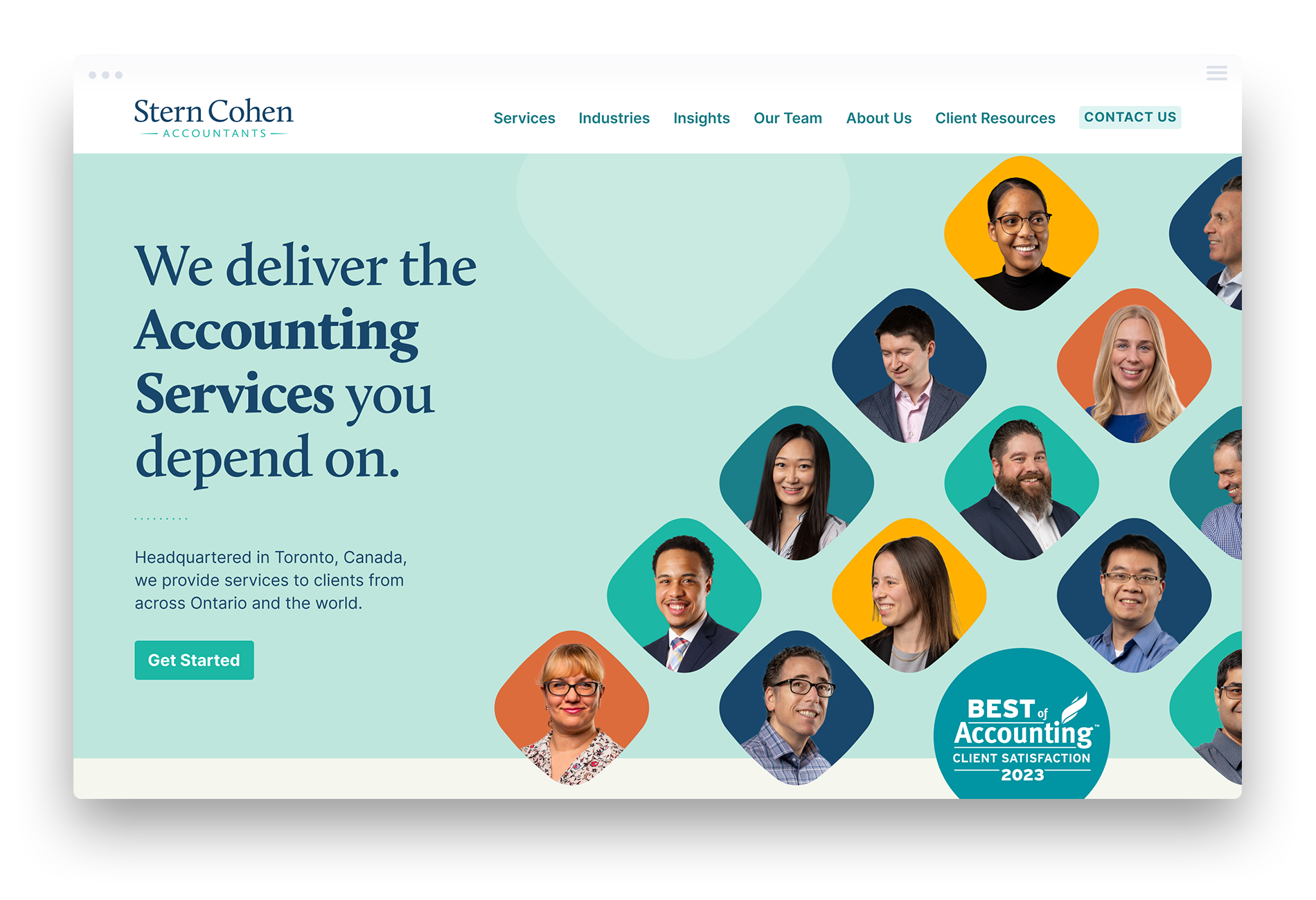
Stern Cohen LLP
Rebranding one of Toronto’s top accounting firms and future-proofing their digital marketing platform.
- Art Direction & Consulting
- Logo Design & Branding
- UX (User Experience) Design
- Responsive Website Design & Build
- Custom WordPress Development
- Secure Client Portal with File Repository
- Secure Tax Worksheet Repository
- Print Marketing Design
AI Search Optimization questions, answered.
We value transparency and keep things clear. If you are not ready to contact us but have a question, the answers below cover the most common ones.
More FAQsAI Search Optimization is the practice of structuring your website and content so that AI-powered systems cite your business in their answers. It covers two named layers. GEO (Generative Engine Optimization) targets large language models like ChatGPT, Claude, and Perplexity. AEO (Answer Engine Optimization) targets Google AI Overviews, AI Mode, featured snippets, and voice answers. The work overlaps on technical foundations but diverges on content structure and distribution.
Read our full guide: Generative Engine Optimization: The Complete Guide to Ranking in AI-Powered Search.
The industry uses both terms and definitions vary by source. Here is how we define them:
- GEO (Generative Engine Optimization): optimization for large language models that synthesize answers from many sources. Examples: ChatGPT, Claude, Perplexity, Gemini. Wins through long-form authority, entity clarity, and brand mentions across trusted domains.
- AEO (Answer Engine Optimization): optimization for answer engines that extract and display a direct response. Examples: Google AI Overviews, AI Mode, featured snippets, voice assistants. Wins through short, extractable answers, FAQ schema, and clean heading logic.
Some practitioners treat GEO as the parent term with AEO as a subset. Others do the reverse. We use the layered framing above because the target surfaces and tactics genuinely differ. You need both.
Both. They target different surfaces and different buyer moments. A user researching a decision on ChatGPT is a GEO opportunity. A user searching on Google and reading the AI Overview is an AEO opportunity. Most businesses need visibility in both places. The underlying technical work and entity signals support each other, so doing both is more efficient than doing one well.
ChatGPT and similar LLMs prioritize sources with strong authority signals: named expert authors, clear factual content, structured data markup, consistent brand mentions across cited domains, and citations from other reputable sources. A GEO strategy addresses each of these systematically. There is no paid placement and no shortcut. Earned authority is the input.
Yes. Traditional SEO is the foundation both GEO and AEO build on. Google still holds over 90% of global search market share, and impressions across Google have increased 49% since AI Overviews launched, even as individual click-through rates drop. You need all three working together.
It is a medium-term strategy. AI engines re-crawl and update continuously, but building the authority signals that drive citation takes 3 to 6 months of consistent work. AEO wins (featured snippets, AI Overview citations for specific queries) can appear faster. GEO wins (LLM citation for category-level prompts) take longer because LLMs weigh brand authority and third-party mention patterns that compound over time.
We track four things: (1) citation share inside AI Overviews and LLM answers for your target prompts, (2) referral traffic from AI platforms, (3) branded search volume as AI exposure builds brand awareness, and (4) traditional organic rankings and conversions. AI-source visibility is the leading indicator. Revenue is the lagging one.
Want your business named when customers ask AI for a recommendation?
AI Search Optimization needs technical precision and a long-term content strategy. Book a call with our Toronto team to talk through where you stand across GEO and AEO and what it takes to get cited.
Book a Call