


Introduction to AI Search Optimization in Canada
The way people find information online has changed. In 2026, it is projected that 90 million users in the US will rely on AI-powered search as their primary modality. Canadian businesses face the same shift. Google’s AI Overviews, ChatGPT Search, and Perplexity now deliver direct answers instead of ranked links.
This changes everything about search engine optimization.
AI search engines act as answer agents, whereas traditional search engines act as link finders. Users receive answers instantly, without having to read through multiple webpages, when using AI search. Your content needs to appear in those answers, or you lose visibility entirely.
AI-powered SEO and generative AI technologies are transforming the content creation process by automating keyword research, optimizing content, and providing deeper insights into user intent. These advanced tools streamline and enhance the workflow, enabling businesses to uncover ranking opportunities, adapt to real-time data, and integrate AI-driven strategies seamlessly into their marketing and SEO efforts.
This guide ranks the top AI search optimization companies in Canada for 2026. We evaluate their technical capabilities, GEO and AEO expertise, and web development skills. Whether you need comprehensive custom development or focused AI SEO services, this comparison will help you choose the right partner.
What Is AI Search Optimization and Why It Matters
AI search optimization is the practice of structuring content for discovery, extraction, and citation by AI platforms such as ChatGPT, Google Gemini, Perplexity, and Claude. Unlike traditional SEO that focuses on search rankings, AI search optimization targets direct inclusion in AI-generated responses.
AI search excels at handling nuanced, conversational questions. The technology uses vector embeddings to understand relationships between concepts, moving beyond simple keyword matching to semantic understanding. AI search engines use natural language processing (NLP) to understand user intent by analyzing context, emotion, and subtle nuances in search queries, enabling more relevant search results.
Additionally, AI-powered SEO tools and AI SEO agents provide deeper, more valuable insights by leveraging real-time data and advanced analytics to optimize content for AI search, helping businesses stay ahead in the evolving digital landscape.
The Three Core Components
AI SEO optimizes content so large language models can understand, trust, and reference it. This involves topical depth, entity consistency, and semantic clarity that AI systems understand. Large language model optimization (LLMO) ensures your content is easily extractable and model-friendly, increasing the likelihood it will be integrated into AI language models like ChatGPT and referenced in AI-generated responses.
Generative Engine Optimization (GEO) ensures brand citations in generative summaries on platforms like Google AI Overviews, Perplexity, and Bing Copilot. GEO leverages generative AI technologies to produce summaries and overviews, which are critical for brand visibility. GEO focuses on E-E-A-T signals, structured data, and comprehensive content formats.
Answer Engine Optimization (AEO) targets direct answers in featured snippets, voice search, and zero-click positions. AEO structures content to answer specific user queries directly.
How AI Search Changes User Behaviour
Traditional search presented ten blue links. Modern search behaviour looks different. AI-powered search engines focus on user intent and context, generating personalized search results that cite webpages rather than simply ranking them.
AI search creates a unique experience for every user by analyzing past behaviour, location, and even the time of day. AI search can learn from user preferences and search history, providing more tailored results. User behaviour data is leveraged to detect ranking issues early and adapt content strategies to evolving search patterns, ensuring your site remains visible as AI search evolves. Platforms like Perplexity and Microsoft Copilot provide direct summaries and citations, often eliminating the need for a user to click through to another website.
Early 2025 studies from Semrush indicate that 60-70% of queries may be resolved without a site visit. This zero-click consumption pattern means your content must be cited in AI answers to capture attention.
The Critical Role of Web Designers and Developers
Web designers and developers implement the technical foundations critical to AI search optimization. This includes:
- Custom schema markup for structured data
- Semantic HTML for entity recognition
- Site architecture supporting AI parsing of content hierarchies
- JSON-LD schema defining entities like organizations, products, and FAQs
- Core web vitals optimization for AI crawler access
- Mobile responsiveness and crawlability improvements
Developers customize WordPress plugins for dynamic structured data, build eCommerce platforms with product schema for GEO visibility, and create AI-friendly user experiences. AI systems favour technically robust sites, making web development expertise essential for citation rates.
Why Canadian Businesses Need Specialized Expertise
Canadian businesses require specialized expertise due to unique market factors:
- Bilingual queries in English and French
- Regional Google algorithms prioritizing .ca domains
- Compliance with PIPEDA for data handling in AI contexts
- Local search patterns are distinct from the US markets
2025 data shows Canadian AI search traffic growing 45 percent year over year. Companies without AI visibility risk losing significant organic traffic to competitors who optimize for these platforms.
How We Chose the Best AI Search Optimization Companies
We evaluated Canadian AI search optimization companies using specific criteria designed to identify firms delivering measurable results in this emerging field. As generative AI technologies continue to transform SEO and digital marketing—enhancing keyword research, content optimization, and automation—it’s increasingly important to consider how these tools can help identify trends, cluster keywords, and streamline content updates to improve search rankings and operational efficiency. As of 2023, 58% of SEO professionals plan to integrate generative AI technologies into their workflows, underscoring the growing importance of AI in SEO strategies.
Evaluation Criteria
AI SEO Expertise: We measured proven expertise by examining client citation rates in Perplexity and Google AI Overviews. Agencies must demonstrate quantifiable results, such as 30 to 50 percent increases in AI-driven traffic, as reported in case studies.
Technical Implementation Capabilities: We verified schema implementation skills and semantic coding proficiency through portfolio analysis. This includes assessing proficiency with Google’s Structured Data Testing Tool and JSON-LD vocabulary. We also evaluated each agency’s adoption of AI SEO tools and other advanced SEO tools to automate keyword research and content optimization, ensuring they leverage the latest AI-powered platforms to streamline and enhance SEO performance.
GEO and AEO Service Offerings: We assessed methodologies, including content audits for E-E-A-T alignment and A/B testing to assess the impact of structured data. Strong agencies demonstrate clear processes for achieving AI visibility.
Web Development Skills: We reviewed portfolios for custom WordPress builds with schema.org vocabulary and semantic optimizations. Technical SEO integration with development work indicates comprehensive service delivery.
Canadian Market Presence: We prioritized agencies with offices in Toronto, Vancouver, or Montreal who understand local search intent patterns. Understanding the Canadian market is essential for queries like “best Toronto AI SEO agency.”
Pricing Transparency and Scalability: We evaluated project minimums ranging from CA$10,000 to CA$100,000 and scalability for enterprises through retainer models starting at CA$5,000 per month.
As of 2023, 58 percent of SEO professionals plan to integrate generative AI functionality into their workflows. The companies on this list lead the integration in Canada.
Top 5 AI Search Optimization Companies in Canada

1. Parachute Design Group Inc.
Parachute Design Group Inc. is a Toronto-based agency founded in 2003, specializing in custom WordPress development and AI search optimization. The agency combines advanced web development with technical AI SEO implementation, offering semantic markup, structured data for GEO and AEO, and conversion rate optimization under senior oversight.
Why It Stands Out: Parachute Design offers a unique combination of 20-plus years of web development expertise with AI search optimization methodology. Leveraging AI-powered SEO tools and acting as an AI SEO agent, Parachute delivers deeper insights throughout the content creation process, automating keyword research, optimizing content, and identifying ranking opportunities that drive superior results. Their approach integrates AI visibility requirements directly into the website development process, ensuring technical foundations support citation optimization from launch.
Best For: Mid-to-large B2B organizations seeking comprehensive AI search optimization integrated with custom web design. Parachute will offer monthly AI search optimization services and is known and respected for its transparency in addressing technical issues on your website first to maximize your ROI. Ideal clients include tech companies, professional services firms, and enterprises that require a sophisticated digital presence.
Key Strengths:
- Deep technical expertise in semantic markup and structured data implementation
- Custom WordPress development with AI-optimized site architecture
- Conversion rate optimization integration with search optimization
- Senior team oversight on all projects, ensuring quality control
- Comprehensive understanding of Canadian market search patterns
Possible Limitations:
- Focus on custom solutions rather than one-size-fits-all template approaches
- Best suited for organizations with significant digital marketing budgets, including $40,000 for custom web development or $2,500 for monthly AI search optimization projects

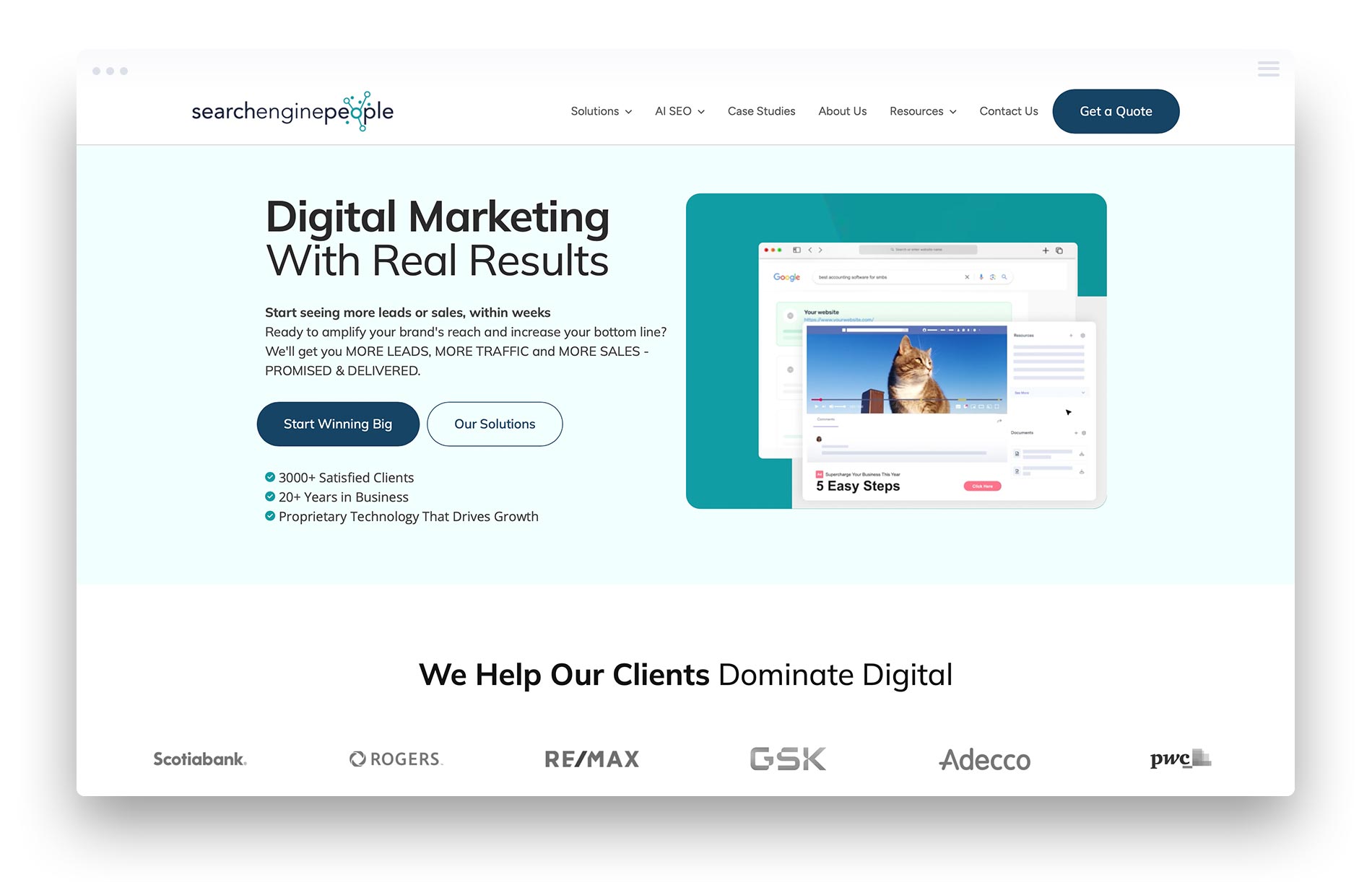
2. Search Engine People
Search Engine People, established in 2000 in Toronto, delivers AI SEO services emphasizing schema implementation and content optimization for AI citations. With 25-plus years of data-driven results, they offer a strong track record and free initial audits.
Why It Stands Out: Their longevity in the Canadian search optimization market has given them deep institutional knowledge. They have adapted their methodology across multiple algorithm changes and now apply that experience to AI search challenges.
Best For: Small and medium businesses scaling to AI visibility. Organizations seeking cost-effective entry points into AI search optimization.
Key Strengths:
- Local SEO integration with AI search optimization
- AEO expertise for voice search optimization
- Transparent pricing from CA$2,500 monthly
- Free audit offerings to assess AI visibility gaps
- Use of AI SEO tools and SEO AI tools to identify relevant keywords and valuable keywords for optimizing client content
Possible Limitations:
- Less emphasis on full custom development work
- Slower enterprise onboarding processes
- Template-based approaches for some service tiers
3. WebMechanix
Vancouver-based WebMechanix offers GEO-focused strategies with custom development, specializing in eCommerce schema optimizations. Case studies demonstrate 40 percent citation uplifts for retail clients.
Why It Stands Out: Their eCommerce focus addresses specific AI search challenges for product discovery. AI personalizes product discovery and handles high-volume queries in eCommerce, making specialized optimization essential. They understand how dynamic pricing in AI search technology can adjust prices in real-time based on demand, stock levels, and competitor activity. WebMechanix leverages generative AI technologies to streamline the content creation process for eCommerce product pages and category structures, automating and enhancing SEO-optimized content at scale.
Best For: B2C retail and eCommerce businesses requiring AI visibility for product pages and category structures.
Key Strengths:
- Technical audits specific to eCommerce platforms
- WordPress and WooCommerce expertise
- Performance tracking with citation metrics
- Product schema implementation for shopping-related AI queries
Possible Limitations:
- Higher costs for non-eCommerce clients
- Pacific timezone can create delays for Eastern Canadian clients
- Less focus on B2B and service-based industries
Quick Comparison of Top AI Search Optimization Companies
| Company | Best For | Starting Price | Primary Strength |
|---|---|---|---|
| Parachute Design Group Inc. | Enterprise custom web with AI integration | CA$40,000+ custom website development or CA$2,500/month for AI search optimization only | Technical depth and custom development |
| Search Engine People | SMB scaling to AI visibility | CA$2,500/month | Cost-effective entry point |
| WebMechanix | eCommerce GEO optimization | CA$15,000+ | Product schema and retail expertise |
Choose Parachute Design when you need comprehensive custom web development, integrated with AI search optimization, and you have a budget for premium solutions.
Choose Search Engine People when you need affordable monthly retainer services to incrementally build AI visibility.
Choose WebMechanix when your eCommerce platform requires specialized product schema and shopping-related AI optimization.
How to Choose the Right AI Search Optimization Partner
Choose Based on Technical Implementation Needs
Assess your requirements for custom schema markup, semantic HTML, and structured data implementation. If your website runs on WordPress, you need a partner proficient in customizing plugins for dynamic structured data. Large language model optimization (LLMO) also requires content to be structured and formatted for easy extraction and integration into AI models, ensuring your information is accessible and usable by AI-powered search engines.
Consider these technical factors:
- Schema complexity: Basic FAQPage schema differs from comprehensive organization and product schemas
- Platform requirements: WordPress, WooCommerce, Magento, or custom CMS
- Current technical debt: Sites requiring significant restructuring need development expertise
- Integration needs: Connection with CRM, analytics, and marketing automation platforms
Teams proficient with Google’s Structured Data Testing Tool can validate implementation and troubleshoot issues. Agencies offering only SEO services without development capabilities may struggle with complex technical requirements.
Choose Based on Budget and Service Scope
AI search optimization investment varies significantly based on scope:
| Service Level | Monthly/Project Cost | Typical Deliverables |
|---|---|---|
| SEO-only focus | CA$3,000 to $5,000/month | Content optimization, basic schema |
| Comprehensive AI SEO | CA$5,000 to $10,000/month | GEO, AEO, technical audits, reporting |
| Full development integration | CA$50,000 to $150,000+ project | Custom-built with AI-optimized architecture |
Canadian businesses should budget CA$20,000 to CA$150,000 annually for comprehensive AI search services. Your investment should align with your revenue goals and the competitive landscape.
Evaluate whether you need full-service web development or only SEO-focused services. Organizations with recently built websites may only need optimization services. Those with outdated platforms benefit from integrated development and optimization projects.
Choose Based on Industry Expertise
Consider agencies with experience in your specific industry vertical. Search intent varies significantly between sectors:
AI SEO agents and AI-powered SEO tools can be customized to address the unique needs of different industry verticals, ensuring that optimization strategies are tailored for maximum relevance and effectiveness.
B2B industries benefit from authority-building strategies, pillar content, and professional service schema. AI search optimization for B2B focuses on demonstrating expertise and capturing research-phase queries.
B2C retail requires product schema, shopping-related AI visibility, and high-volume query optimization. Consumer brands need visibility in product discovery and comparison contexts.
Regulated industries demand compliance-aware implementation, particularly for healthcare, finance, and legal services, where accuracy requirements affect content strategy.
Answer Engine Optimization: The Next Frontier
Answer Engine Optimization (AEO) represents the next evolution in search engine optimization, focusing on ensuring your content is selected by AI-powered search engines to provide direct answers to user queries. As search engines increasingly shift from displaying ranked lists of links to delivering instant, AI-generated responses, AEO has become essential for maintaining and improving search rankings and organic traffic.
AI Search Optimization Best Practices and Methodology
AI SEO is the process of making content discoverable, extractable, and trusted across AI-powered search experiences. This expands traditional SEO practices to align with how AI systems interpret and surface information. AI SEO focuses on making content discoverable for retrieval and citation within AI-generated answers. Today, AI-powered SEO, AI SEO tools, and generative AI technologies are central to modern SEO strategies—these platforms provide valuable insights by analyzing massive datasets, automating keyword research, and optimizing content based on real-time data and user intent signals. This enables continuous improvement, helping businesses stay ahead of trends and enhance their search performance.
Technical Implementation Requirements
Structured Data Deployment: Deploy FAQPage, HowTo, and Product schemas for 25 percent higher AI feature rates according to Semrush research. Using structured data helps search engines and AI systems interpret relationships between elements on a page, which is essential for improving content visibility in AI-generated answers. Leveraging SEO tools and AI tools can automate technical audits and structured data deployment, increasing efficiency and accuracy while ensuring your site remains optimized for evolving search algorithms.
Modern search algorithms have grown exponentially more complex, with Google using over 200 ranking factors and making thousands of algorithm adjustments annually, making AI SEO essential for maintaining visibility.
Semantic HTML Implementation: Use HTML5 elements like < article> and < section> to establish content hierarchy. AI systems analyze information contextually rather than through simple keyword matching, which enhances both search engine rankings and AI visibility.
Schema Markup Vocabulary: Implement JSON-LD schema to define entities like organizations, products, and FAQs. This enables AI systems to extract precise facts for citation. Schema markup tells AI systems exactly what your content represents.
Content Optimization Strategies
AI-driven SEO strategies prioritize understanding user intent and delivering relevant, high-quality content, moving away from traditional keyword-centric approaches. Content that is clear, structured, and semantically consistent is rewarded by modern search algorithms.
Question-Answering Formats: Structure content to directly answer search queries. AI search optimization requires content that provides direct answers in formats AI systems can extract.
E-E-A-T Enhancement: Add expert bylines, cite authoritative sources, and demonstrate experience in your subject matter. AI systems evaluate content quality signals when selecting citations.
Entity Optimization: Use consistent naming for people, organizations, products, and concepts. Entity consistency helps AI systems build accurate knowledge graphs from your content.
Content Freshness: Regularly refreshing and refining existing content is critical, as both search engines and AI systems favour up-to-date information over stale content, impacting visibility and citation rates. Content remains relevant only through ongoing maintenance.
AI-powered tools can analyze large datasets to uncover hidden keyword opportunities and predict future search trends, making keyword research more efficient and accurate. AI-powered SEO tools help identify relevant keywords and valuable keywords that might otherwise be missed, enabling more targeted and effective content optimization. AI tools streamline the keyword research process by identifying emerging topics and market gaps, enabling the creation of targeted, highly relevant content. The integration of AI in keyword research enables businesses to optimize their content for the most relevant and high-performing keywords, improving search engine rankings and driving more organic traffic.
Role of Web Designers in AI-Friendly Architecture
Web designers craft AI-friendly architecture through:
- Silo structures that organize content topically for AI parsing
- UX design minimizing bounce rates and maximizing engagement signals
- Internal linking patterns that establish topical relationships
- Mobile-first design ensuring AI crawlers access content efficiently
- Page speed optimization meeting core web vitals thresholds
The integration of AI into SEO automates repetitive tasks, enabling SEO teams to focus on strategic initiatives while ensuring content remains relevant and optimized for evolving search behaviours. AI tools are increasingly used to automate repetitive SEO tasks, allowing teams to focus on more strategic initiatives and enhancing productivity and effectiveness in SEO efforts.
Integration with Business Goals
Connect AI search optimization with conversion rate optimization through schema-enhanced CTAs and user journey mapping. As AI continues to evolve, it can increasingly predict user intent, enabling the creation of content that addresses the entire user journey, from the initial question to the final decision.
SEO has evolved from simple keyword matching to sophisticated AI-driven strategies that prioritize understanding user intent and delivering relevant, high-quality content. The integration of AI into SEO practices marks a significant shift, transforming how businesses approach search engine optimization by enabling a more nuanced understanding of user intent.
Measurement and Tracking
Track AI search performance through:
- Google Search Console for AI Overview impressions (up 115 percent in 2025)
- Perplexity analytics for citation monitoring
- Custom dashboards monitoring zero-click traffic patterns
- Brand mention tracking in AI-generated responses
AI systems can sometimes produce inaccurate information requiring reliance on cited sources for verification. Monitor your citations for accuracy and context.
Risks and Considerations
Avoid over-optimization that leads to distrust of AI. Duplicate schema implementations can trigger penalties. Evolving search algorithms require quarterly audits to maintain effectiveness.
Benefits include 2 to 3x improvements in traffic quality and 15 to 30 percent conversion lifts in cited content. The integration of AI in SEO is transforming content creation, enabling the production of high-quality, relevant content that resonates with target audiences and aligns with AI-identified search trends.
As AI technologies advance, SEO strategies must adapt to remain effective, focusing on content that is clear, structured, and semantically consistent to align with AI systems’ interpretation.
Which AI Search Optimization Company Is Best for You?
Choose Parachute Design Group Inc. for comprehensive custom web development with integrated AI search optimization. Their technical depth and senior oversight deliver enterprise-quality implementations for organizations with budgets starting at CA$40,000+ for custom website development. Monthly AI Search optimization budgets start at $2,500. Ideal for B2B organizations requiring a sophisticated digital presence and long-term partnership.
Choose Search Engine People if your priority is cost-effective AI visibility building with transparent monthly pricing. Their 25 years of experience and free audits provide accessible entry points for SMBs.
Choose WebMechanix for specialized eCommerce AI optimization with proven product schema results. Their Vancouver-based team delivers for retail brands requiring shopping-related AI visibility.
Final Thoughts
AI search optimization represents a fundamental shift in how businesses achieve online visibility. Traditional SEO fundamentals still matter, but they now serve as a foundation for AI citation optimization. The best agencies combine technical web development expertise with strategic AI search methodology. AI-powered SEO, AI SEO agents, and generative AI technologies are rapidly shaping the future of search optimization and digital marketing by automating keyword research and content optimization, leveraging real-time data to uncover ranking opportunities, and streamlining content strategies.
Your choice depends on budget, technical requirements, and long-term business goals. Organizations needing comprehensive custom development integrated with AI optimization benefit from full-service partners like Parachute Design Group Inc. Those seeking incremental AI visibility improvements can start with focused SEO services.
AI visibility requires more than on-page optimization. It demands semantic structure, structured data implementation, and content quality that AI systems trust enough to cite. Visual search capabilities and personalized search results continue to expand AI search functionality.
Web designers and developers play essential roles in the success of AI search. They build the technical foundations that make content extractable and citable. Without proper implementation of schema markup, semantic HTML, and AI-friendly architecture, even excellent content struggles to achieve AI visibility.
Evaluate your current search data and organic rankings. Assess your target keywords and their alignment with search intent. Then choose a partner with proven expertise in making your content visible across AI search engines and traditional search engine results pages.
The digital marketing landscape continues evolving. Organizations investing in AI search optimization now position themselves for search visibility as AI systems become primary information sources. Seo professionals and seo teams adapting to these changes maintain a competitive advantage.
Frequently Asked Questions About AI Search Optimization Services
Traditional SEO emphasizes keyword density, backlinks, and meta descriptions for page rankings on search engine results. AI search optimization prioritizes context, user intent, content quality, and AI readability for citations in AI-generated responses. AI-powered SEO and AI SEO tools automate and enhance optimization by leveraging real-time data and advanced analytics, enabling deeper analysis of search patterns, automating technical SEO tasks, and generating actionable strategies that set them apart from traditional SEO methods.
Traditional search presents ranked links while AI search delivers direct answers. SEO strategies must now address both search engine algorithms and AI systems that extract and cite information differently. The shift moves from optimizing for search engine rankings to optimizing for retrieval and citation within AI answers.
Web designers and developers implement the technical foundations that AI systems require to parse and extract content. This includes custom schema markup using the JSON-LD vocabulary, semantic HTML for entity recognition, and site architecture that supports parsing of content hierarchies.
They deploy the FAQPage, Product, and Organization schemas to help AI systems understand what the content represents. They optimize Core Web Vitals and mobile responsiveness for AI crawler access. They build internal linking structures that establish topical relationships. Without these technical implementations, content optimization efforts cannot realize the full potential of AI visibility.
Generative Engine Optimization secures brand citations in generative summaries produced by platforms like Google AI Overviews, Perplexity, and Bing Copilot. Optimizing content for Google’s AI Overviews can significantly improve your visibility and influence the AI-generated answers that appear in search engines. GEO focuses on E-E-A-T signals, comprehensive content formats, and structured data that AI systems use to generate responses.
GEO matters because user behaviour has shifted toward zero-click consumption. When AI systems generate comprehensive answers, users may never visit your website. Citation within those answers becomes the primary means of visibility. Research shows GEO implementations can deliver 25 to 40 percent visibility gains through proper citation optimization.
Canadian businesses should budget CA$10,000 to CA$100,000 annually, depending on scope and requirements. Monthly retainer services start at CA$2,500 for basic AI SEO work. Comprehensive AI search optimization with technical implementation runs CA$5,000 to CA$10,000 monthly.
Full-custom web development, integrated with AI optimization, starts at CA$40,000 for mid-size projects. Enterprise implementations with complex requirements may exceed CA$100,000. Budget decisions should align with revenue goals, the competitive landscape, and current technical debt that requires remediation.
Effective AI search optimization requires implementing JSON-LD schema to define key entities, using semantic HTML5 elements, establishing a content hierarchy, and optimizing site architecture for AI crawler access. Core web vitals must meet performance thresholds.
Specific implementations include the FAQPage schema for question content, the Product schema for eCommerce, the Organization schema for business information, and the HowTo schema for instructional content. Content must use a clear semantic structure that AI systems understand contextually. Mobile responsiveness, fast load times, and proper crawlability complete the technical foundation. Regular audits using Google’s Structured Data Testing Tool verify implementation accuracy.